
Noncanonical Function of Caspase-5 in Intestinal Epithelial Renewal
The Biological Problem The intestinal epithelium is one of the fastest renewing tissues in the body, completely replacing itself every few days to maintain a protective barrier against microbes while absorbing nutrients. This remarkable process relies on a steep Wnt/β-catenin signaling gradient — highest at the crypt base near stem cells and gradually diminishing as cells migrate upward toward the lumen. Too little Wnt leads to failed repair; too much risks uncontrolled growth and dysplasia. In inflammatory bowel disease (IBD), repeated injury disrupts this delicate balance, resulting in poor healing, chronic inflammation, barrier breakdown, and significantly elevated long-term risk of colorectal cancer. Despite its central importance, we still lacked a clear molecular explanation for how human cells precisely fine-tune Wnt activity in the right place and at the right time during repair. At the same time, our lab had a long-standing interest in inflammatory caspases. Caspase-5 (CASP5) was particularly enigmatic. Although it is closely related to caspase-4 and capable of binding bacterial lipopolysaccharide (LPS), it appeared largely dispensable for non-canonical inflammasome activation in most contexts — unlike caspase-4, which plays a clear role in detecting cytosolic bacteria and triggering inflammation. This raised a fundamental question: if CASP5 is not primarily functioning in classical immune defense in the gut, what is it actually doing there?
How We Addressed It We began by mapping the tissue distribution of CASP5. Unlike its close relative CASP4, which is expressed ubiquitously across tissues, CASP5 showed a strikingly restricted pattern — almost exclusively in the human intestinal epithelium. Using proximity labeling (BioID2) in human colonic organoids, we made an unexpected discovery: CASP5 interacts with Dishevelled (DVL), a central hub protein in the Wnt signaling pathway. This finding bridged two seemingly unrelated fields — innate immunity and epithelial regeneration — and prompted us to investigate the three major CASP5 isoforms and their distinct functions, then return to the intact intestinal epithelium to map their spatial expression along the natural Wnt gradient.
What We Found We discovered that CASP5 functions as a previously unrecognized isoform-dependent rheostat for Wnt signaling. The CARD-less isoform CASP5c powerfully amplifies Wnt activity by enzymatically cleaving APC at residue D556, disrupting the β-catenin destruction complex and stabilizing β-catenin. In contrast, the CARD-containing isoforms CASP5a and CASP5b compete with CASP5c for Dishevelled binding but cannot cleave APC, thereby restraining Wnt signaling and promoting differentiation. Spatially, CASP5c is enriched in transit-amplifying cells — the proliferative progenitors that must continue dividing even as the Wnt signal begins to fade — while CASP5a and CASP5b predominate in mature enterocytes higher up the crypt. In tissue from patients with ulcerative colitis and Crohn’s disease, CASP5c levels are selectively elevated in areas undergoing active repair.
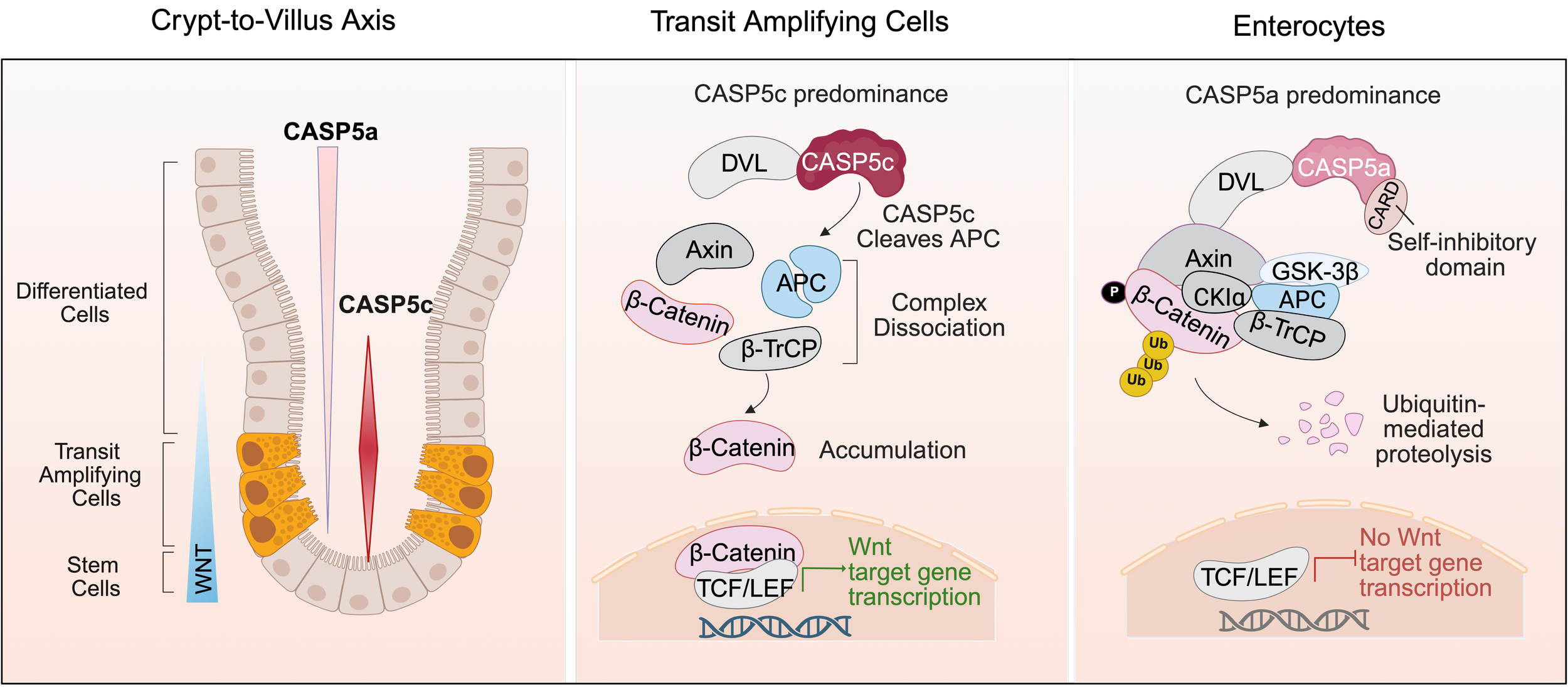
Why These Findings Matter This work reveals a beautiful human-specific mechanism that repurposes an ancient immune protein to control epithelial renewal. It shows how the gut uses a built-in molecular rheostat to maintain the delicate balance between proliferation and differentiation along the crypt–lumen axis. The findings have direct relevance to IBD, where impaired repair perpetuates chronic inflammation and increases cancer risk. By identifying CASP5c as a novel enzymatic regulator of Wnt activity, this discovery deepens our fundamental understanding of intestinal homeostasis and opens new possibilities for therapies that could enhance mucosal healing while limiting pathological overgrowth.
Opportunities for Trainees This project is actively expanding, and we are looking for motivated students, postdocs, and fellows to join the team. There are exciting opportunities to contribute to mechanistic studies, spatial transcriptomics, organoid engineering, in vivo models, and translational directions. If you are passionate about bridging innate immunity, epithelial biology, and regenerative medicine — and want to work on high-impact questions with direct relevance to human disease — we encourage you to reach out.